BEGIN:VCALENDAR
VERSION:2.0
CALSCALE:GREGORIAN
METHOD:PUBLISH
PRODID://APSA//211081
BEGIN:VEVENT
DTSTAMP:20260412T220812
VTIMEZONE:America/New_York
DTSTART:20260505T040000Z
DTEND:20260614T040000Z
UID:211081
SUMMARY:Do No Harm: Interviewing Skills Needed When There’s a Concern of Child Abuse: The Why, The When, and The How
LOCATION:
DESCRIPTION:Do No Harm: Interviewing Skills Needed When There’s a Concern of Child Abuse: The Why, The When, and The How\n\n05/05/26 12:00 AM EST\n - 06/14/26 12:00 AM EST\Description:\n\nChoose A Package Below\n\n\n \n \n Packages\n Prices\n Date and Time\n Location\n \n \n Module 1\n \n (16 Hours) – all dates required\n $458 non-member\n $325 member\n \n May 5, 2026\n 12:00 PM ET – 4:30 PM ET\n\n May 7, 2026\n 12:00 PM ET – 4:30 PM ET\n\n May 19, 2026\n 12:00 PM ET – 4:30 PM ET\n\n May 21, 2026\n 12:00 PM ET – 4:30 PM ET\n \n Live, Interactive Zoom\n \n \n Module 2\n \n (7 Hours In-Person)\n $283 non-member\n $250 member\n \n June 14, 2026\n 8:30 AM CT - 4:30 PM CT \n In-Person, Interactive:\n \n \n New Orleans, LA – APSAC 33rd Annual Colloquium\n \n \n Module 3*\n \n (17 Hours) – all dates required\n \n \n $458 non-member\n $325 member\n TBA\n Live, Interactive Zoom\n \n \n Modules 1, 2 and 3*\n \n (40 hours Total)\n $1,199 non-member\n $900 member\n See Dates Above\n Modules 1 + 3 Live, Interactive Zoom\n \n Module 2 in New Orleans, LA\n \n \n To Be Announced : Optional Advanced Course Add-Ons include Forensic Mental Health Evaluations and Child Forensic Interviewing for Non Forensic-Interviewers\n \n \n\n\n\n \n \n\n\nA First-of-Its-Kind, Multi-Module Training Series\n\nFor professionals who may talk with children about abuse — outside official CAC forensic interview roles. Whether in mental health, healthcare, education, child welfare, law enforcement, or frontline work, gain the skills to respond safely without causing harm.\n\n \n\nLearn the Why, When & How\n\nSafe, developmentally appropriate, evidence-informed interviewing skills — stay in your role and reduce risk.\n\n\nWhy does this training matter?\n\n\n Fills a national gap for non-CAC interviewers\n Promotes trauma-informed, child-centered, legally sound practice\n Led by national experts in forensic interviewing & child protection\n\n\n_______________________________________________\n\nModule 1: The Why and the When?\n\n\n Describe the historical context of child maltreatment and common myths, biases, statistics, scope of problem factors that increase risk of child maltreatment.\n Distinguish the roles of CPS, LE, FI, and other involved.\n Learn the indicators, effects, and dynamics of abuse.\n Demonstrate how to respond and when to refer and when to gather additional information.\n Review Disclosure and Recantation research \n Summarize disclosure types, methods and reasons for delay.\n Describe the research on memory and suggestibility.\n Translate the research that clearly reveals that a supportive non-offending caregiver is critical to the resiliency of the child and learn how your role can help the non-offending caregiver to believe and support the child.\n Learn how to effectively engage families and non-offending caregivers.\n Summarize the impact of Adverse Childhood Experiences (ACEs) and the opportunities to incorporate resilience in investigative response.\n Demonstrate the ability to react and respond to a child or adolescent disclosing abuse.\n Identify individualized triggers, strengths, resources, resilience, and preventative strategies. \n Distinguish essential facts.\n Prepare for testimony.\n\n\nModule 2: The Practice of How? \n\n\n Define Roles. Participants will describe why, when, and how to talk with children when abuse and violence are a concern. \n Describe Skills for Gathering Information from Children. Rapport building, narrative event practice, transition to concern, open-ended questions, recording information, and supporting trauma-informed closure.\n Demonstrate Ways of Talking with Children that are Supportive, Warm, and Sustain Rapport. Role play and practice.\n Apply Open-Ended Questioning Techniques: Participants will learn how to utilize open-ended questions and narrative event practice to gather accurate, reliable information from children about their experiences.\n Demonstrate Non-Invasive Interviewing Skills: Participants will learn techniques to establish rapport and conduct child-friendly, non-invasive conversations that encourage children to share concerns and basic information.\n Explain Supportive Conversations for Child Well-being: Professionals will be able to more effectively respond to children's statements in a manner that supports ongoing investigations, maintains trust, and prioritizes the child's emotional safety.\n *Note: Module 2 will be offered in-person at the APSAC Colloquium Pre-Conference on June 14, 2026.\n\n\nMODULE 3: The How and Beyond – Research-Informed Interviewing\n\nPrerequisite: Module 1 must be completed prior to attending Module 3. Module 2 must be completed or registered for prior to attending Module 3.\n\n\n Demonstrate the ability to differentiate the purpose of the non-forensic interviewer interview from a formal child forensic interview. \n Explain the key stages of research-informed interviewing and how these stages may differ from a formal child forensic interview. \n Evaluate the quality of interview questions by understanding the type of questions used.\n Give examples of how to prioritize and maximize open-ended questions to elicit accurate narratives and reliable information from children.\n Explain the best ways to structure their interviews to support the child and future investigation.\n Demonstrate knowledge of language and memory development to generating interview questions.\n Identify how child development and linguistic considerations affect abilities of children to understand and respond to adult questioning.\n Identify and give examples of age-appropriate questions and ways of assessing child’s developmental level and abilities.\n Demonstrate knowledge of challenges to talking with children and ways of reducing drift. Make a plan for avoiding draft. \n Explain key memory concepts critical in effective child interviewing: How children's memories differ from adults, Recall v. Recognition memory, Memory source monitoring, Script memory\n Give examples of key memory concept questions critical in effective child interviewing: Recall memory, Recognition memory, Memory source monitoring, Script memory, Episodic memory\n Summarize key principles of best practice interview techniques and components gleaned from the research, with reference to key provisions of the APSAC Practice Guidelines on Forensic Interviewing in Cases of Suspected Child Abuse.\n Explain next steps to a child and supportive family members (as needed) that match practitioners role in the interview process.\n\n \n\nMore Information\n\nProfessionals in many settings have contact with children who may have witnessed or been a victim of violence. Children sometimes make statements that are as alarming as they are unclear, resulting in a professional feeling anxious about child safety and confusion about how to manage a mandated report. In some situations, professionals need clarity regarding a child’s statement and in other situations professionals need to get some information from a child before or after an investigation and child forensic interview.\n \nThis training will teach child serving professionals across disciplines how to talk with the child in a non-invasive manner that allows the child to provide basic information about the concerns and feel supported in the process. Specific emphasis will be on how to enhance rapport building throughout an interview, address the importance of including narrative event practice prior to talking about the issue of concern, and will teach specific interview techniques focusing on the use of open-ended questions from narrative event practice through basic questioning about the concerns.\n \nPresenters will cover memory and cognitive development research and the values of these skills. Presenters will also provide an overview of the components of child maltreatment investigations and child forensic interviewing. Attendees will learn and practice new skills that may help them respond effectively to children who make statements that raise child maltreatment or family violence concerns. The goal of using these skills is to support the child, get helpful basic information, and enhance, not hinder an investigation.\n\nPresenter Bio's linked here: \nPatti Toth, JD\nJulie Kenniston, MSW, LISW \nStacie LeBlanc, JD, MEd, FAPSAC\nViola Vaughan-Eden, PhD, MSW, MJ, FAPSAC\nLuanne McKenna, MS, JD\nKelly Champion, PhD, ABPP\nLaura Merchant, MSW, LICSW\n\nRegistration will remain open through the start of the Webinar\n\nContinuing Education Information:\n\nModule 1: 16 CE Credits (Social Work & Psychology): $60\nModule 3: 17 CE Credits (Social Work & Psychology): $60\nTarget Audience and Content Level: Multidisciplinary professionals / Intermediate\nInteractive, Live Zoom\n\nModule 2: Credits can be purchased at the APSAC Colloquium CE page Linked here\n\nWe would love to see you! Please be prepared to have your camera on whenever possible. It helps create a more connected and engaging experience for everyone. If you need to turn it off, we trust you to take care of yourself. If you are requesting continuing education credit, being on camera is required for verification purposes. We appreciate your understanding and participation!\n\n \nZoom Webinar System Requirements\nFor the best experience, use a computer or mobile device with a stable internet connection. Please have the latest version of Zoom installed, along with working speakers and a microphone. A webcam is required if you're requesting continuing education credit.\n\nCE Course Completion Steps\n\n\n Register for the live, interactive webinar.\n Attend the full session (please have camera on).\n Complete a posttest (with a passing score of 70% and option to retest up to two additional times) or engage with discussion questions embedded within webinar-you will be notified at start of webinar.\n Submit evaluation form\n Receive your certificate electronically through email within 30 days.\n\n\nAccessibility Accommodations: To request accessibility accommodations, please contact APSAC at onlinetraining@apsac.org.\n\n \nProvider Statements:\nSocial Work: The American Professional Society on the Abuse of Children (APSAC), provider #1622, is approved as a provider for social work continuing education by the Association of Social Work Boards (ASWB ), www.aswb.org, through the Approved Continuing Education ( ACE ) program. APSAC maintains responsibility for the program. ASWB Approval Period: 7/27/2025-7/27/2028. Social workers should contact their regulatory board to determine course approval for continuing education credits. The Social worker participating in this conference will receive up to 33 continuing education clock hours.”\n \nPsychology: The American Professional Society on the Abuse of Children, Inc (APSAC) is approved by the American Psychological Association (APA) to sponsor continuing education for psychologists. The American Professional Society on the Abuse of Children maintains responsibility for this program and its contents. \n\n\nCancellations and Refunds: No cancellations. No refunds. Registration is transferable. Requests for transfer to a future event will also be considered on a case-by-case basis. If you have any questions, please email us at onlinetraining@apsac.org.\n\nQuestions and Concerns: Please contact the APSAC team at onlinetraining@apsac.org\n
X-ALT-DESC;FMTTYPE=text/html:Do No Harm: Interviewing Skills Needed When There’s a Concern of Child Abuse: The Why, The When, and The How
05/05/26 12:00 AM EST - 06/14/26 12:00 AM EST
Description:
Choose A Package Below
| Packages |
Prices |
Date and Time |
Location |
Module 1
(16 Hours) – all dates required |
$458 non-member
$325 member |
May 5, 2026
12:00 PM ET – 4:30 PM ET
May 7, 2026
12:00 PM ET – 4:30 PM ET
May 19, 2026
12:00 PM ET – 4:30 PM ET
May 21, 2026
12:00 PM ET – 4:30 PM ET
|
Live, Interactive Zoom |
Module 2
(7 Hours In-Person) |
$283 non-member
$250 member |
June 14, 2026
8:30 AM CT - 4:30 PM CT |
In-Person, Interactive:
New Orleans, LA – APSAC 33rd Annual Colloquium |
Module 3*
(17 Hours) – all dates required
|
$458 non-member
$325 member |
TBA |
Live, Interactive Zoom |
Modules 1, 2 and 3*
(40 hours Total) |
$1,199 non-member
$900 member |
See Dates Above |
Modules 1 + 3 Live, Interactive Zoom
Module 2 in New Orleans, LA |
| To Be Announced : Optional Advanced Course Add-Ons include Forensic Mental Health Evaluations and Child Forensic Interviewing for Non Forensic-Interviewers |
A First-of-Its-Kind, Multi-Module Training Series
For professionals who may talk with children about abuse — outside official CAC forensic interview roles. Whether in mental health, healthcare, education, child welfare, law enforcement, or frontline work, gain the skills to respond safely without causing harm.
Learn the Why, When & How
Safe, developmentally appropriate, evidence-informed interviewing skills — stay in your role and reduce risk.
Why does this training matter?
- Fills a national gap for non-CAC interviewers
- Promotes trauma-informed, child-centered, legally sound practice
- Led by national experts in forensic interviewing & child protection
_______________________________________________
Module 1: The Why and the When?
- Describe the historical context of child maltreatment and common myths, biases, statistics, scope of problem factors that increase risk of child maltreatment.
- Distinguish the roles of CPS, LE, FI, and other involved.
- Learn the indicators, effects, and dynamics of abuse.
- Demonstrate how to respond and when to refer and when to gather additional information.
- Review Disclosure and Recantation research
- Summarize disclosure types, methods and reasons for delay.
- Describe the research on memory and suggestibility.
- Translate the research that clearly reveals that a supportive non-offending caregiver is critical to the resiliency of the child and learn how your role can help the non-offending caregiver to believe and support the child.
- Learn how to effectively engage families and non-offending caregivers.
- Summarize the impact of Adverse Childhood Experiences (ACEs) and the opportunities to incorporate resilience in investigative response.
- Demonstrate the ability to react and respond to a child or adolescent disclosing abuse.
- Identify individualized triggers, strengths, resources, resilience, and preventative strategies.
- Distinguish essential facts.
- Prepare for testimony.
Module 2: The Practice of How?
- Define Roles. Participants will describe why, when, and how to talk with children when abuse and violence are a concern.
- Describe Skills for Gathering Information from Children. Rapport building, narrative event practice, transition to concern, open-ended questions, recording information, and supporting trauma-informed closure.
- Demonstrate Ways of Talking with Children that are Supportive, Warm, and Sustain Rapport. Role play and practice.
- Apply Open-Ended Questioning Techniques: Participants will learn how to utilize open-ended questions and narrative event practice to gather accurate, reliable information from children about their experiences.
- Demonstrate Non-Invasive Interviewing Skills: Participants will learn techniques to establish rapport and conduct child-friendly, non-invasive conversations that encourage children to share concerns and basic information.
- Explain Supportive Conversations for Child Well-being: Professionals will be able to more effectively respond to children's statements in a manner that supports ongoing investigations, maintains trust, and prioritizes the child's emotional safety.
*Note: Module 2 will be offered in-person at the APSAC Colloquium Pre-Conference on June 14, 2026.
MODULE 3: The How and Beyond – Research-Informed Interviewing
Prerequisite: Module 1 must be completed prior to attending Module 3. Module 2 must be completed or registered for prior to attending Module 3.
- Demonstrate the ability to differentiate the purpose of the non-forensic interviewer interview from a formal child forensic interview.
- Explain the key stages of research-informed interviewing and how these stages may differ from a formal child forensic interview.
- Evaluate the quality of interview questions by understanding the type of questions used.
- Give examples of how to prioritize and maximize open-ended questions to elicit accurate narratives and reliable information from children.
- Explain the best ways to structure their interviews to support the child and future investigation.
- Demonstrate knowledge of language and memory development to generating interview questions.
- Identify how child development and linguistic considerations affect abilities of children to understand and respond to adult questioning.
- Identify and give examples of age-appropriate questions and ways of assessing child’s developmental level and abilities.
- Demonstrate knowledge of challenges to talking with children and ways of reducing drift. Make a plan for avoiding draft.
- Explain key memory concepts critical in effective child interviewing: How children's memories differ from adults, Recall v. Recognition memory, Memory source monitoring, Script memory
- Give examples of key memory concept questions critical in effective child interviewing: Recall memory, Recognition memory, Memory source monitoring, Script memory, Episodic memory
- Summarize key principles of best practice interview techniques and components gleaned from the research, with reference to key provisions of the APSAC Practice Guidelines on Forensic Interviewing in Cases of Suspected Child Abuse.
- Explain next steps to a child and supportive family members (as needed) that match practitioners role in the interview process.
More Information
Professionals in many settings have contact with children who may have witnessed or been a victim of violence. Children sometimes make statements that are as alarming as they are unclear, resulting in a professional feeling anxious about child safety and confusion about how to manage a mandated report. In some situations, professionals need clarity regarding a child’s statement and in other situations professionals need to get some information from a child before or after an investigation and child forensic interview.
This training will teach child serving professionals across disciplines how to talk with the child in a non-invasive manner that allows the child to provide basic information about the concerns and feel supported in the process. Specific emphasis will be on how to enhance rapport building throughout an interview, address the importance of including narrative event practice prior to talking about the issue of concern, and will teach specific interview techniques focusing on the use of open-ended questions from narrative event practice through basic questioning about the concerns.
Presenters will cover memory and cognitive development research and the values of these skills. Presenters will also provide an overview of the components of child maltreatment investigations and child forensic interviewing. Attendees will learn and practice new skills that may help them respond effectively to children who make statements that raise child maltreatment or family violence concerns. The goal of using these skills is to support the child, get helpful basic information, and enhance, not hinder an investigation.
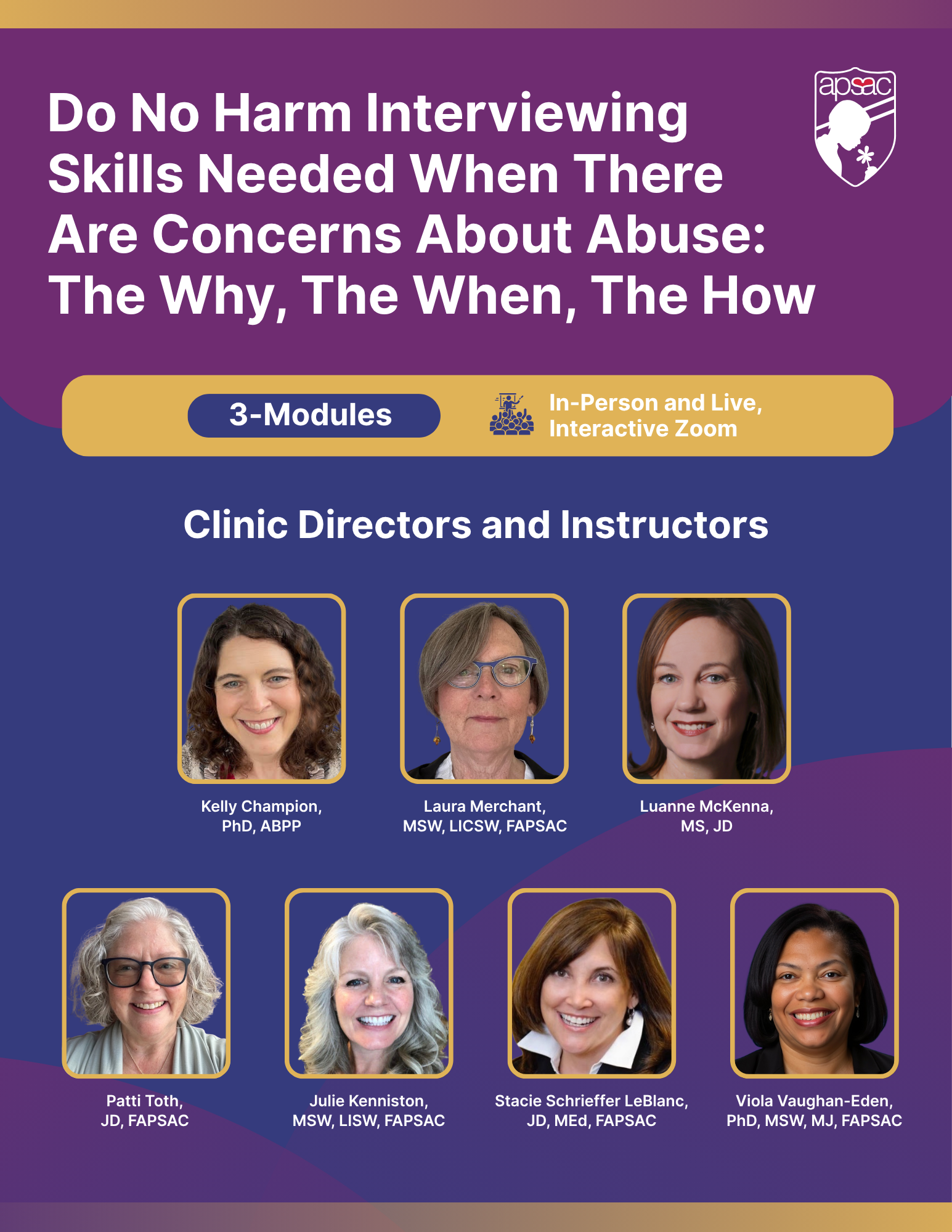
Presenter Bio's linked here:
Patti Toth, JD
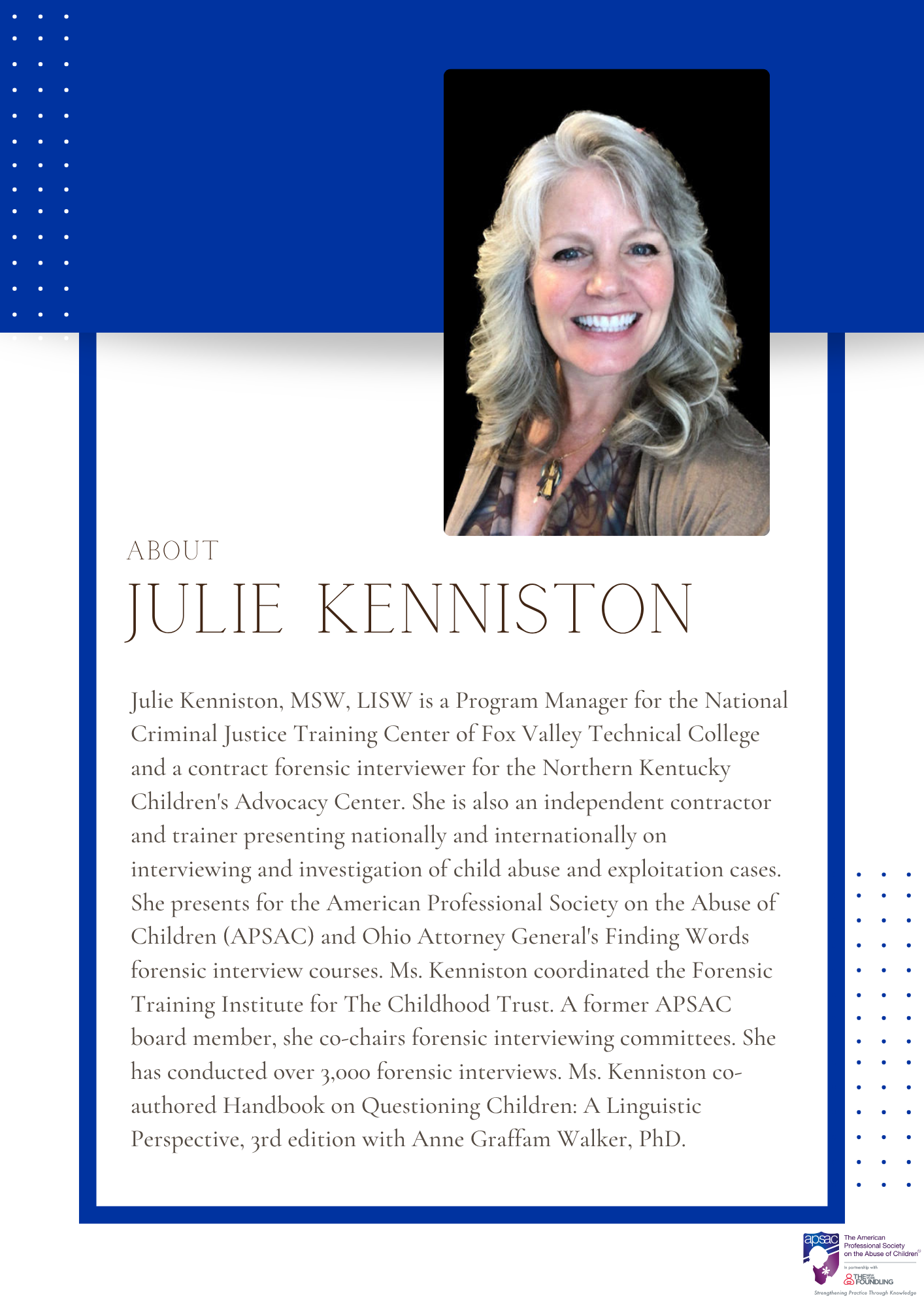
Julie Kenniston, MSW, LISW
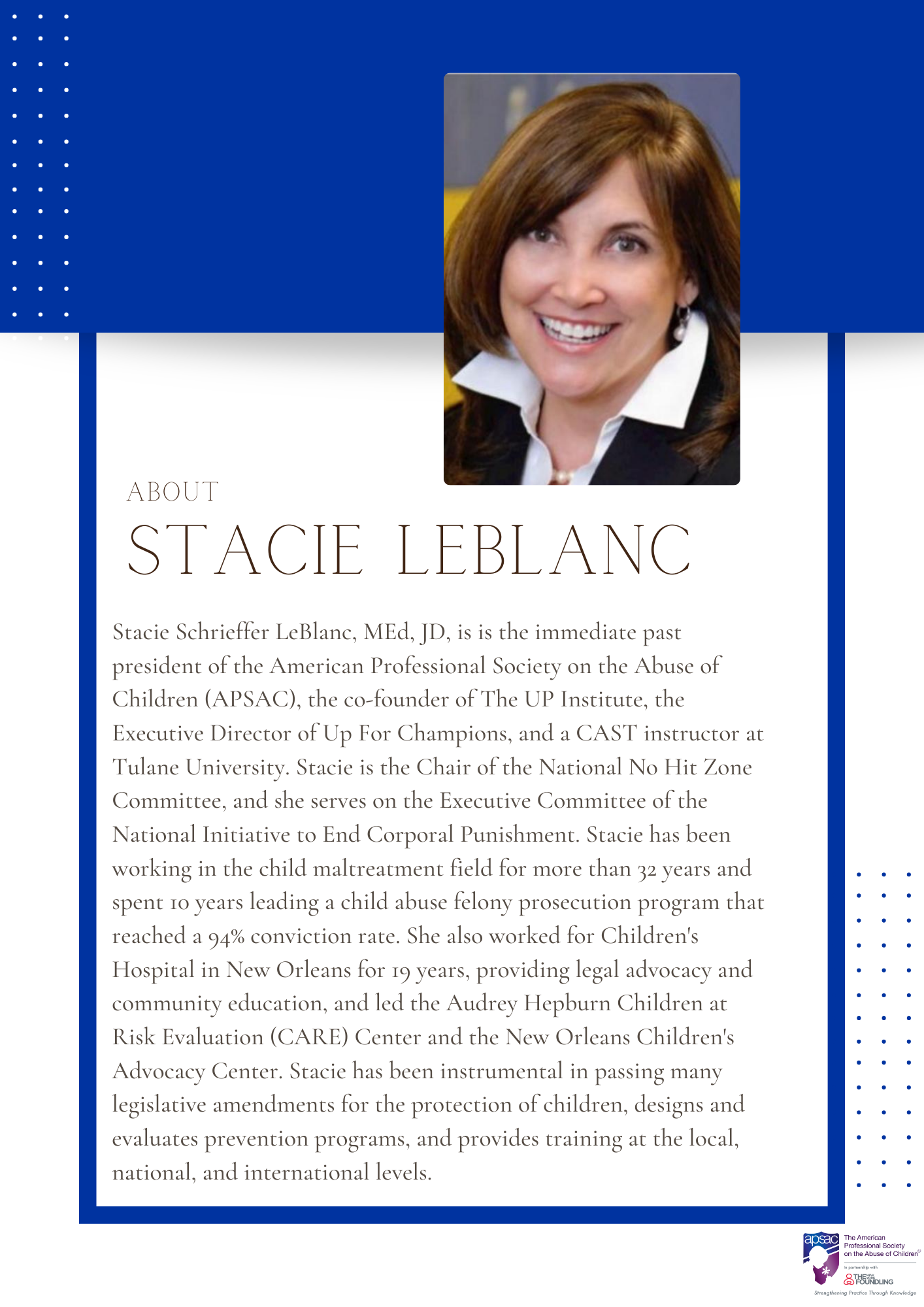
Stacie LeBlanc, JD, MEd, FAPSAC
Viola Vaughan-Eden, PhD, MSW, MJ, FAPSAC
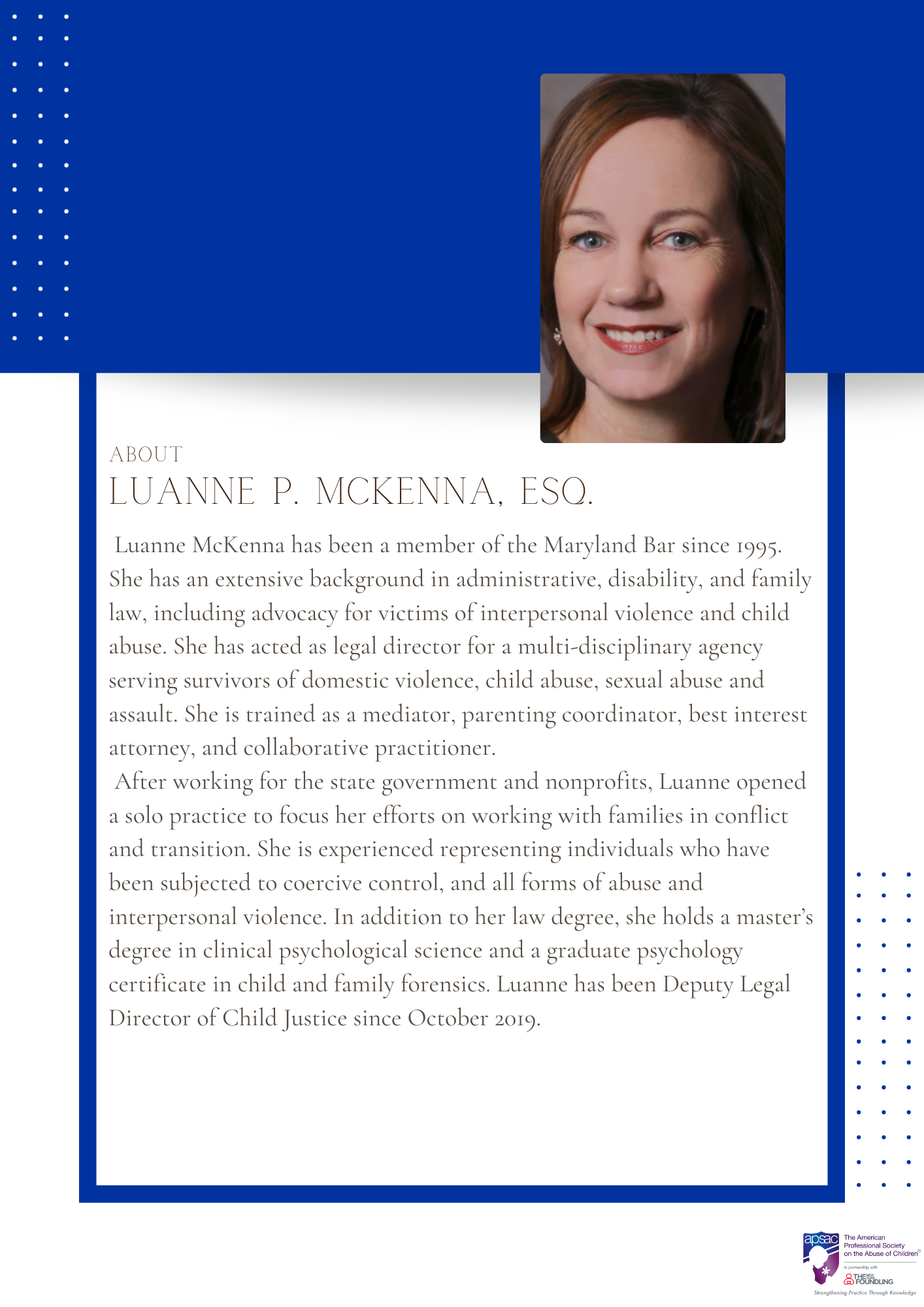
Luanne McKenna, MS, JD
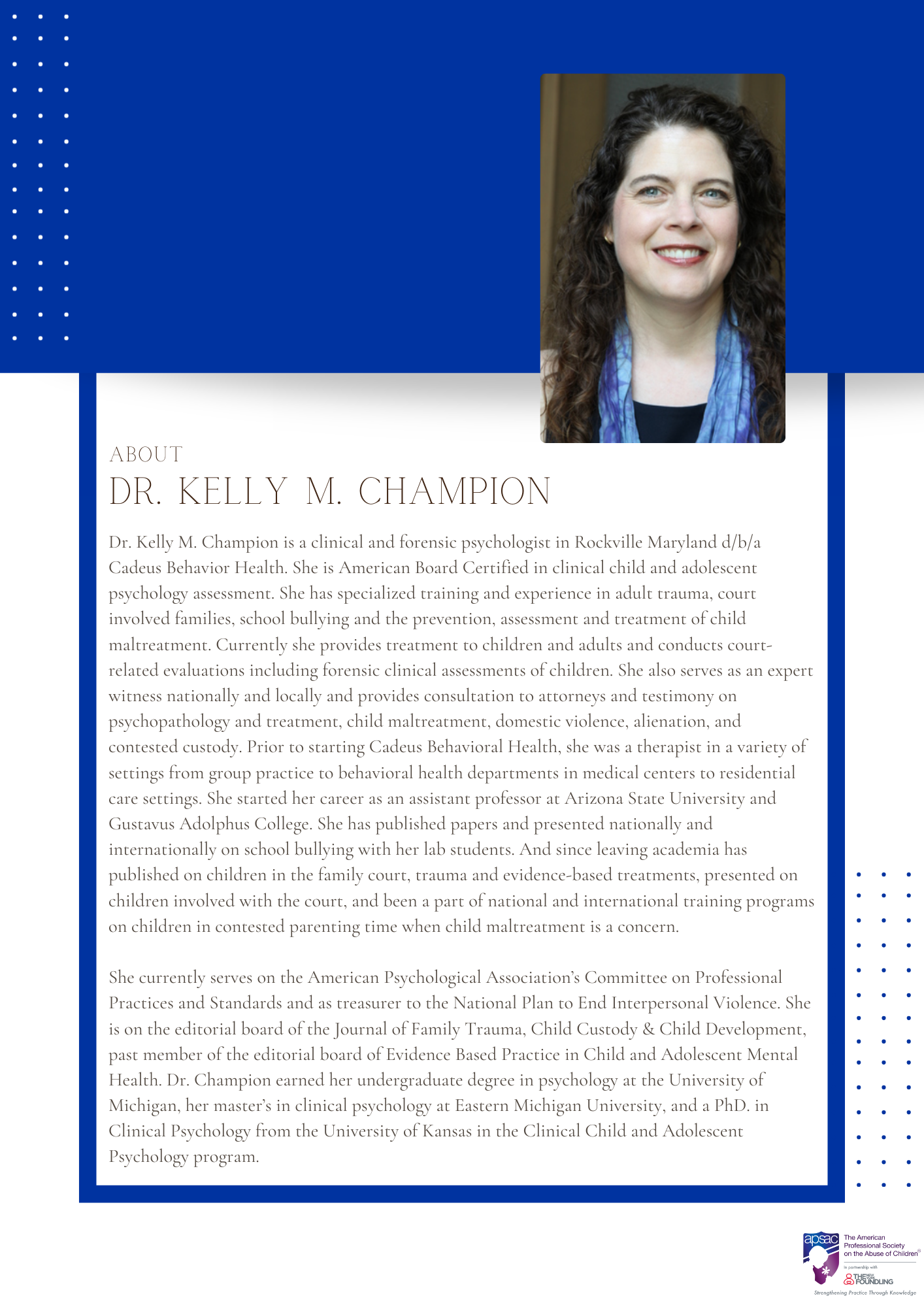
Kelly Champion, PhD, ABPP
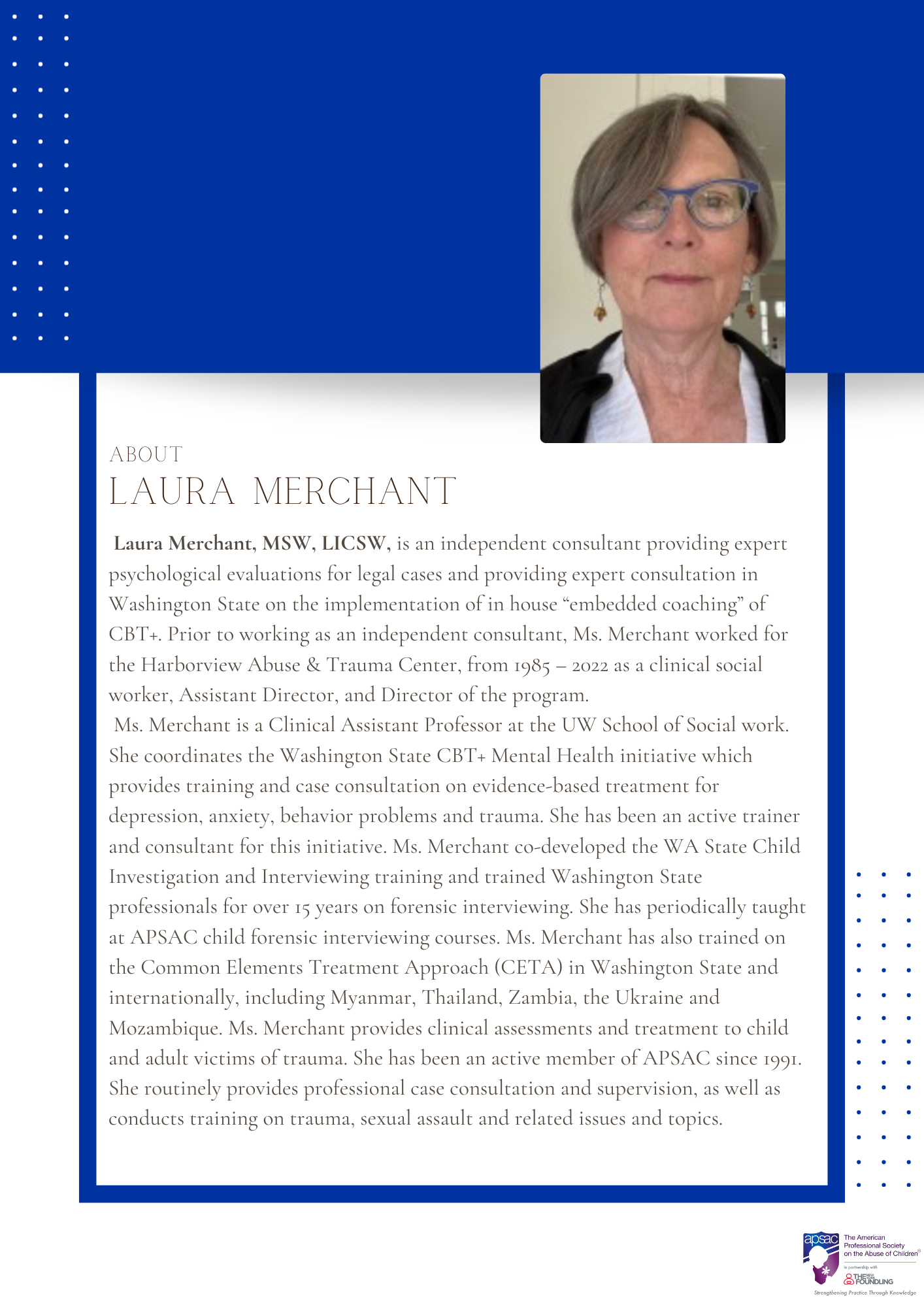
Laura Merchant, MSW, LICSW
Registration will remain open through the start of the Webinar
Continuing Education Information:
Module 1: 16 CE Credits (Social Work & Psychology): $60
Module 3: 17 CE Credits (Social Work & Psychology): $60
Target Audience and Content Level: Multidisciplinary professionals / Intermediate
Interactive, Live Zoom
Module 2: Credits can be purchased at the APSAC Colloquium CE page Linked here
We would love to see you! Please be prepared to have your camera on whenever possible. It helps create a more connected and engaging experience for everyone. If you need to turn it off, we trust you to take care of yourself. If you are requesting continuing education credit, being on camera is required for verification purposes. We appreciate your understanding and participation!
Zoom Webinar System Requirements
For the best experience, use a computer or mobile device with a stable internet connection. Please have the latest version of Zoom installed, along with working speakers and a microphone. A webcam is required if you're requesting continuing education credit.
CE Course Completion Steps
- Register for the live, interactive webinar.
- Attend the full session (please have camera on).
- Complete a posttest (with a passing score of 70% and option to retest up to two additional times) or engage with discussion questions embedded within webinar-you will be notified at start of webinar.
- Submit evaluation form
- Receive your certificate electronically through email within 30 days.
Accessibility Accommodations: To request accessibility accommodations, please contact APSAC at onlinetraining@apsac.org.
Provider Statements:
Social Work: The American Professional Society on the Abuse of Children (APSAC), provider #1622, is approved as a provider for social work continuing education by the Association of Social Work Boards (ASWB ), www.aswb.org, through the Approved Continuing Education ( ACE ) program. APSAC maintains responsibility for the program. ASWB Approval Period: 7/27/2025-7/27/2028. Social workers should contact their regulatory board to determine course approval for continuing education credits. The Social worker participating in this conference will receive up to 33 continuing education clock hours.”
Psychology: The American Professional Society on the Abuse of Children, Inc (APSAC) is approved by the American Psychological Association (APA) to sponsor continuing education for psychologists. The American Professional Society on the Abuse of Children maintains responsibility for this program and its contents.
Cancellations and Refunds: No cancellations. No refunds. Registration is transferable. Requests for transfer to a future event will also be considered on a case-by-case basis. If you have any questions, please email us at onlinetraining@apsac.org.
Questions and Concerns: Please contact the APSAC team at onlinetraining@apsac.org
PRIORITY:3
TRANSP:TRANSPARENT
BEGIN:VALARM
TRIGGER:-PT5M
ACTION:DISPLAY
DESCRIPTION:Reminder
END:VALARM
END:VEVENT
END:VCALENDAR