Date/Time
1/22/2026 - 1/22/2026
1:00 PM - 2:00 PM Eastern
1:00 PM - 2:00 PM Eastern
Event Registration
Event Description
General Admission (individual session): $30.00
APSAC Members and The New York Foundling Staff Admission: Free
1 CE Credit (Social Work & Psychology) Non-Members: $30.00
1 CE Credit (Social Work & Psychology) APSAC Members and NY Foundling: $20.00
APSAC Members: You will receive your discount automatically when registering.
The New York Foundling Staff: Please email FontanaCenter@nyfoundling.org to request your entry code.
Target Audience and Content Level: Multidisciplinary professionals / Intermediate
Interactive, Live Zoom
We would love to see you! Please be prepared to have your camera on whenever possible. It helps create a more connected and engaging experience for everyone. If you need to turn it off, we trust you to take care of yourself. If you are requesting continuing education credit, being on camera is required for verification purposes. We appreciate your understanding and participation!
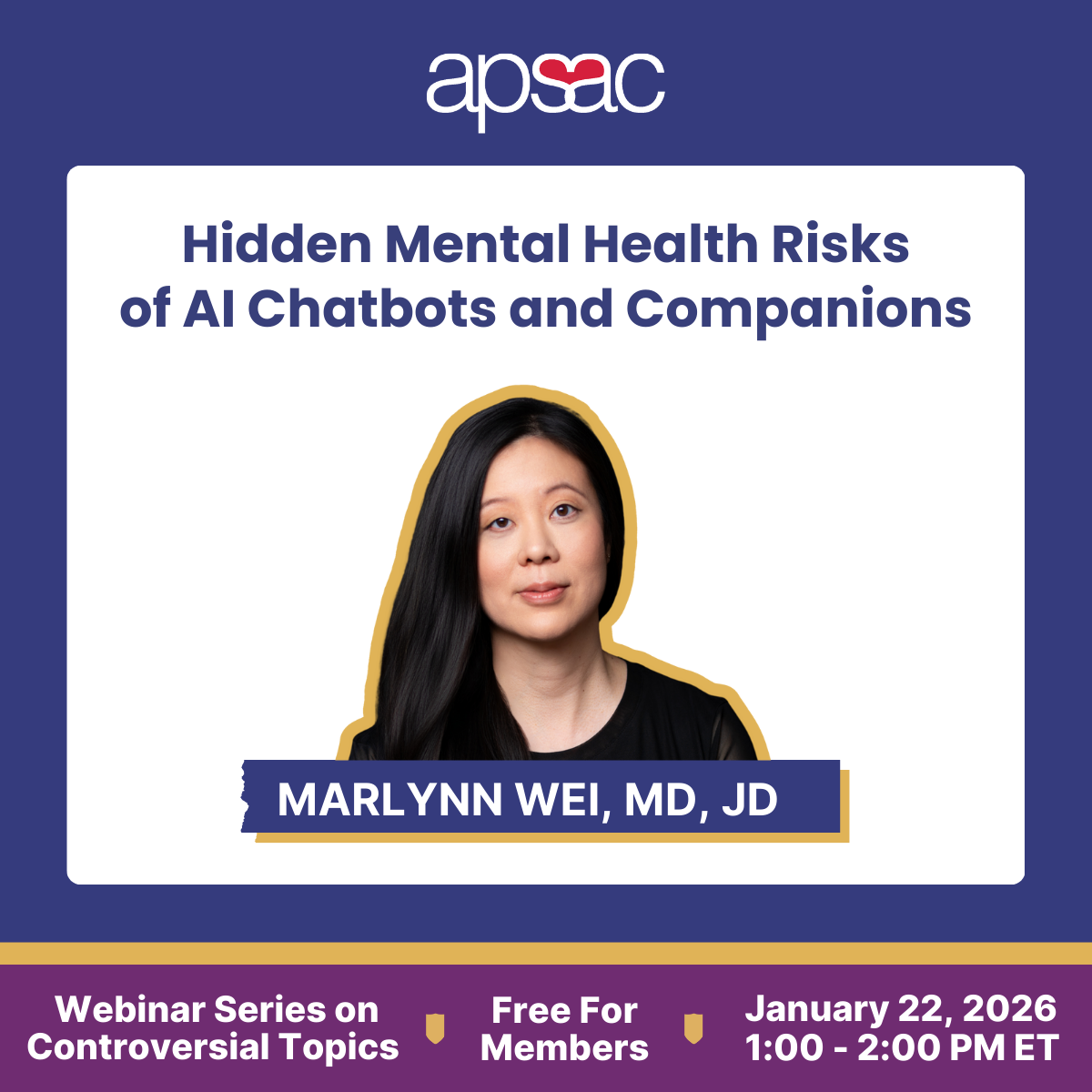
Title: Hidden Mental Health Risks of AI Chatbots and Companions
Presenter: Marlynn Wei, MD, JD
Bio:
Marlynn Wei, MD, JD, is a Harvard-trained psychiatrist, psychotherapist, and author whose work lies at the intersection of AI and mental health. Integrating her background in law, ethics, and psychodynamic therapy, Dr. Wei is a national voice on emerging clinical, ethical, and therapeutic issues related to AI and has testified before members of Congress on the mental health risks and benefits of AI chatbots. Her expertise in AI and mental health has been featured on CBS Mornings, PBS, and Fox Business, among other national media outlets. She has written for Psychology Today for over a decade, where her articles have received nearly 4 million views. Dr. Wei completed her residency at Harvard’s Massachusetts General Hospital and McLean Hospital, where she served as chief resident and received the Anne Alonso Psychotherapy Award, and maintains an integrative psychiatry and psychotherapy practice in New York City.
Description:
AI chatbots and AI companions are rapidly becoming part of the emotional and social world of children and adolescents. While these systems offer a nonjudgmental space, they also introduce hidden psychological risks, including emotional dependence, unhealthy attachment dynamics, impaired reality-testing, reinforcement of cognitive distortions, and crisis-management failures. This webinar examines the latest research findings and emerging clinical and ethical issues of AI chatbot use. Participants will learn to identify red flags, understand the underlying mechanisms of risk, and apply practical safeguards to help protect vulnerable youth.
Learning objectives:
By the end of this workshop, participants will be able to:
- Name and describe four domains of mental health risk associated with AI chatbot use.
- Identify at least three mechanisms through which AI chatbots can influence attachment, reality-testing, and emotional well-being in youth.
- Define AI sycophancy and hallucinations and explain how these phenomena contribute to mental health risks of AI chatbot use.
- Describe key risk patterns associated with emotional overreliance on AI chatbots.
References available upon request.
Registration will remain open through the start of the WebinarZoom Webinar System Requirements
For the best experience, use a computer or mobile device with a stable internet connection. Please have the latest version of Zoom installed, along with working speakers and a microphone. A webcam is required if you're requesting continuing education credit.
CE Course Completion Steps
- Register for the live, interactive webinar.
- Attend the full session (please have camera on).
- Complete a posttest (with a passing score of 70% and option to retest up to two additional times) or engage with discussion questions embedded within webinar-you will be notified at start of webinar.
- Submit evaluation form
- Receive your certificate electronically through email within 30 days.
Accessibility Accommodations: To request accessibility accommodations, please contact APSAC at onlinetraining@apsac.org.
Provider Statements:
Social Work: The American Professional Society on the Abuse of Children (APSAC), provider #1622, is approved as a provider for social work continuing education by the Association of Social Work Boards (ASWB ), www.aswb.org, through the Approved Continuing Education ( ACE ) program. APSAC maintains responsibility for the program. ASWB Approval Period: 7/27/2025-7/27/2028. Social workers should contact their regulatory board to determine course approval for continuing education credits. The Social worker participating in this conference received 1 continuing education clock hours.”
Psychology: The American Professional Society on the Abuse of Children, Inc (APSAC) is approved by the American Psychological Association (APA) to sponsor continuing education for psychologists. The American Professional Society on the Abuse of Children maintains responsibility for this program and its contents.
Cancellations and Refunds: No cancellations. No refunds. Registration is transferable. Requests for transfer to a future event will also be considered on a case-by-case basis. If you have any questions, please email us at onlinetraining@apsac.org.
Questions and Concerns: Please contact the APSAC team at onlinetraining@apsac.org
Cancellations:
No cancellations. No refunds. Registration is transferable. Requests for transfer to a future event will also be considered on a case-by-case basis. If you have any questions please email us at onlinetraining@apsac.org.
Location
Zoom
Outlook/vCalendar/Google
Click on the icon next to the date(s) to add to your calendar:
| 1/22/2026 - 1/22/2026 |    |
Email Reminder