| Date | Event | ||||||||||||||||||||||||
| 1/15/2026 -12/17/2026 | The APSAC Prevention Series returns in 2026 will be held on the 3rd Thursday of the month. This is a monthly opportunity to learn from leading experts in child maltreatment prevention and child well-being offered to expand your toolkit with the strategies and resources needed to implement effective prevention practices and improve outcomes for children and families. Member Registration: Free Non-Member Registration: $149 APSAC MEMBERSHIP INFORMATION 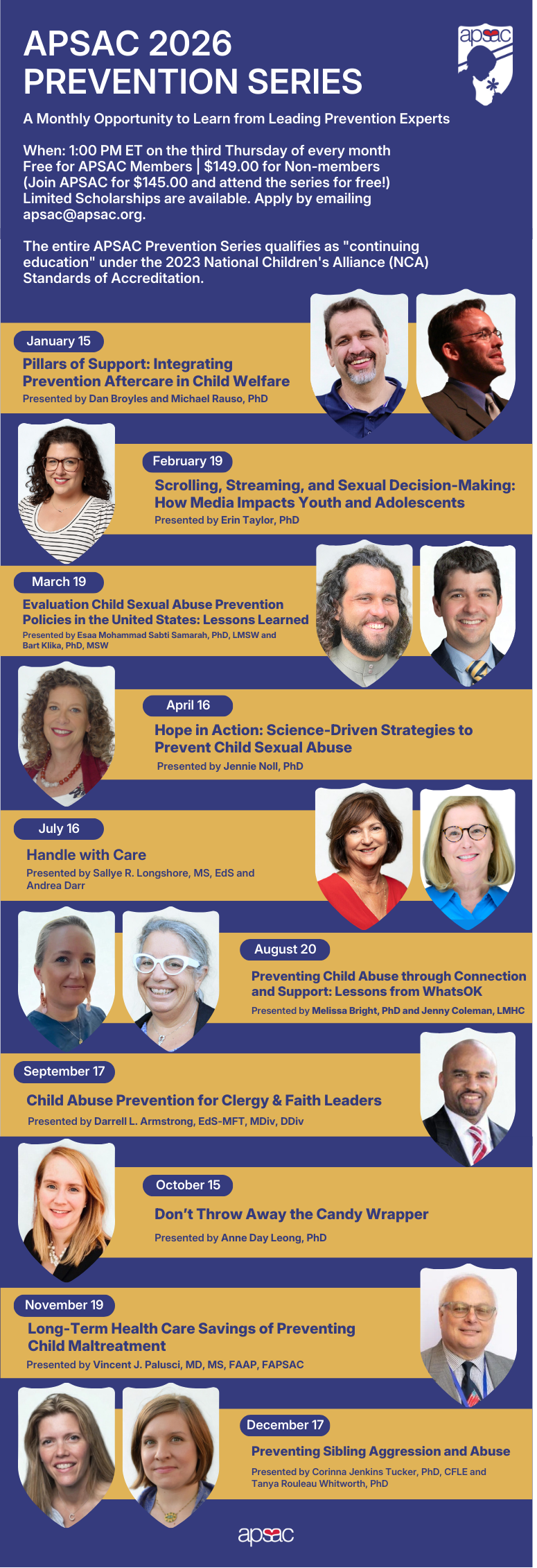 January 15, 2026: presented by Pastor Dan Broyles and Dr. Michael Rauso February 19, 2026: presented by Erin Taylor, PhD March 19, 2026: presented by Esaa Mohammad Samarah & Bart Klika, PhD April 16, 2026: presented by Jennie Noll, PhD May and June: Summer Break July 16, 2026: presented by Sallye R. Longshore, MS, EdS & Andrea Darr August 20, 2026: presented by Mellissa Bright, PhD & Jenny Coleman, LMHC November 19, 2026: presented by Vincent J. Palusci, MD, MS, FAAP, FAPSAC September 17: presented by Darrell L. Armstrong, EdS-MFT, MDiv, DDiv, FAPSAC October 15: presented by Anne Day Leong, PhD December 17, 2026: presented by Corinna Jenkins Tucker, PhD, CFLE & Tanya Rouleau Whitworth, PhD | ||||||||||||||||||||||||
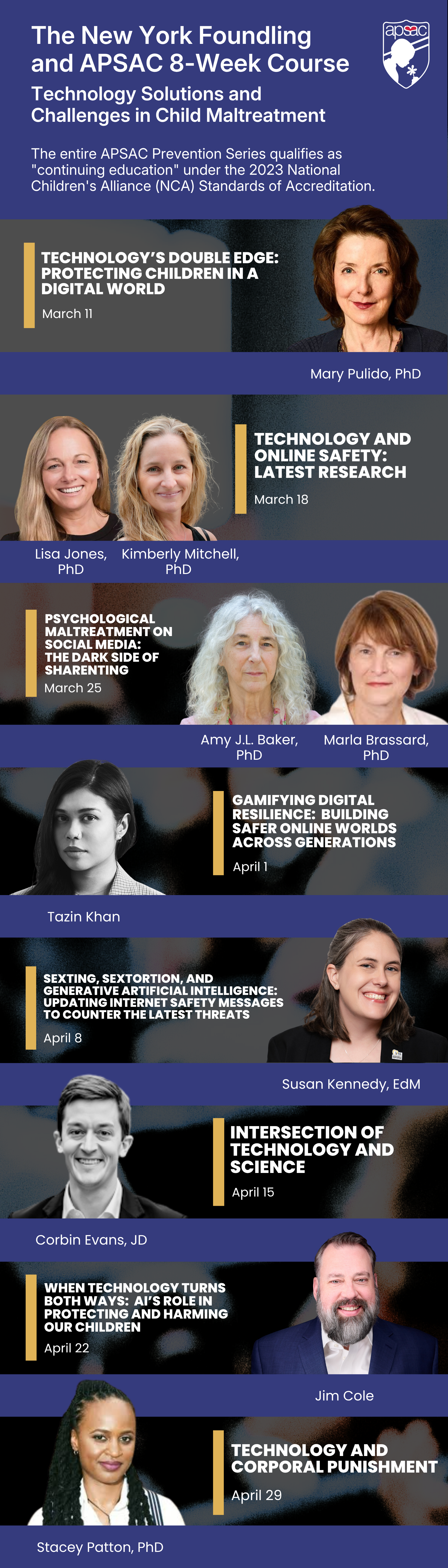
| 3/11/2026 -4/29/2026 |
Registration will remain open through the start of the Webinar
Accessibility Accommodations: To request accessibility accommodations, please contact APSAC at onlinetraining@apsac.org. more info... | ||||||||||||||||||||||||
| 5/5/2026 -6/14/2026 | 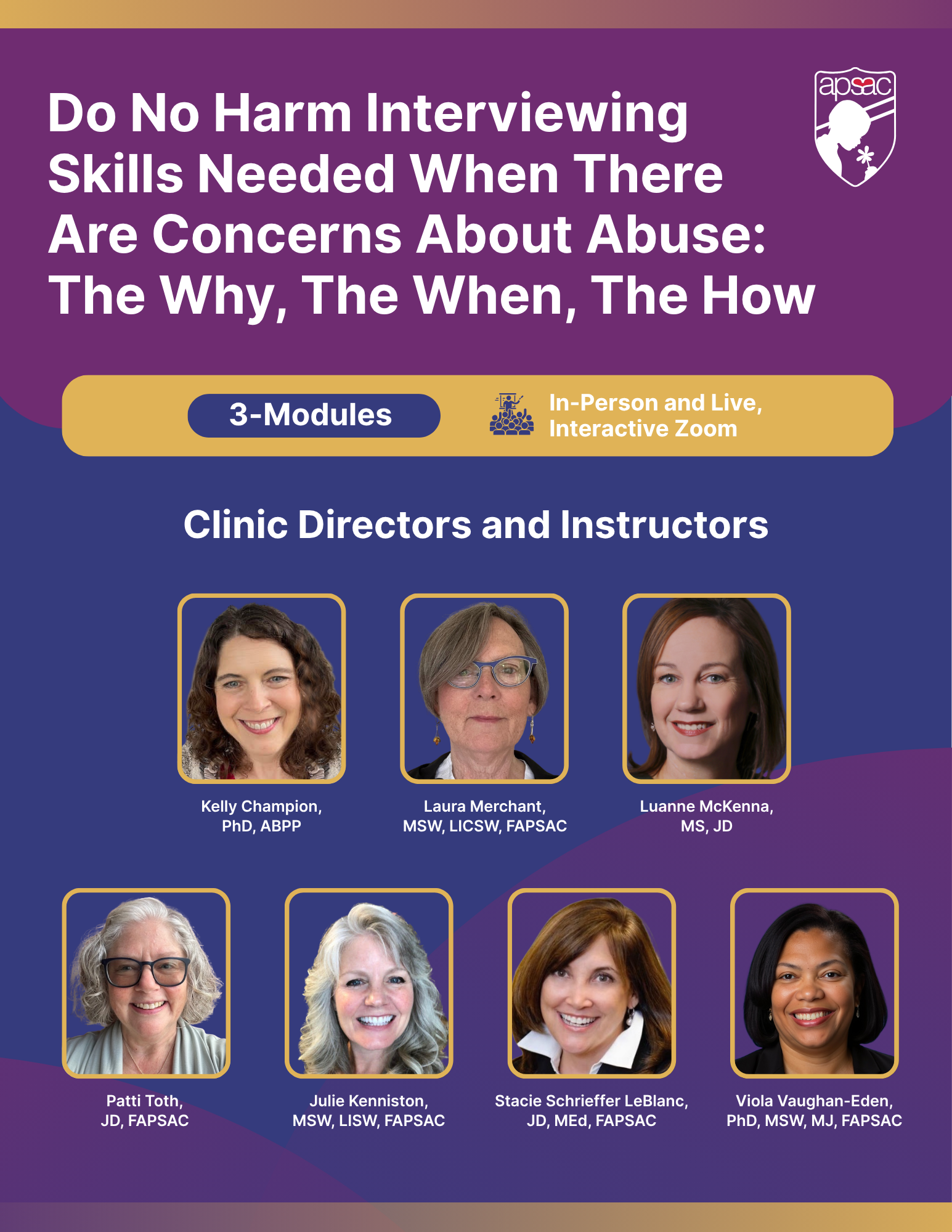
Choose A Package Below
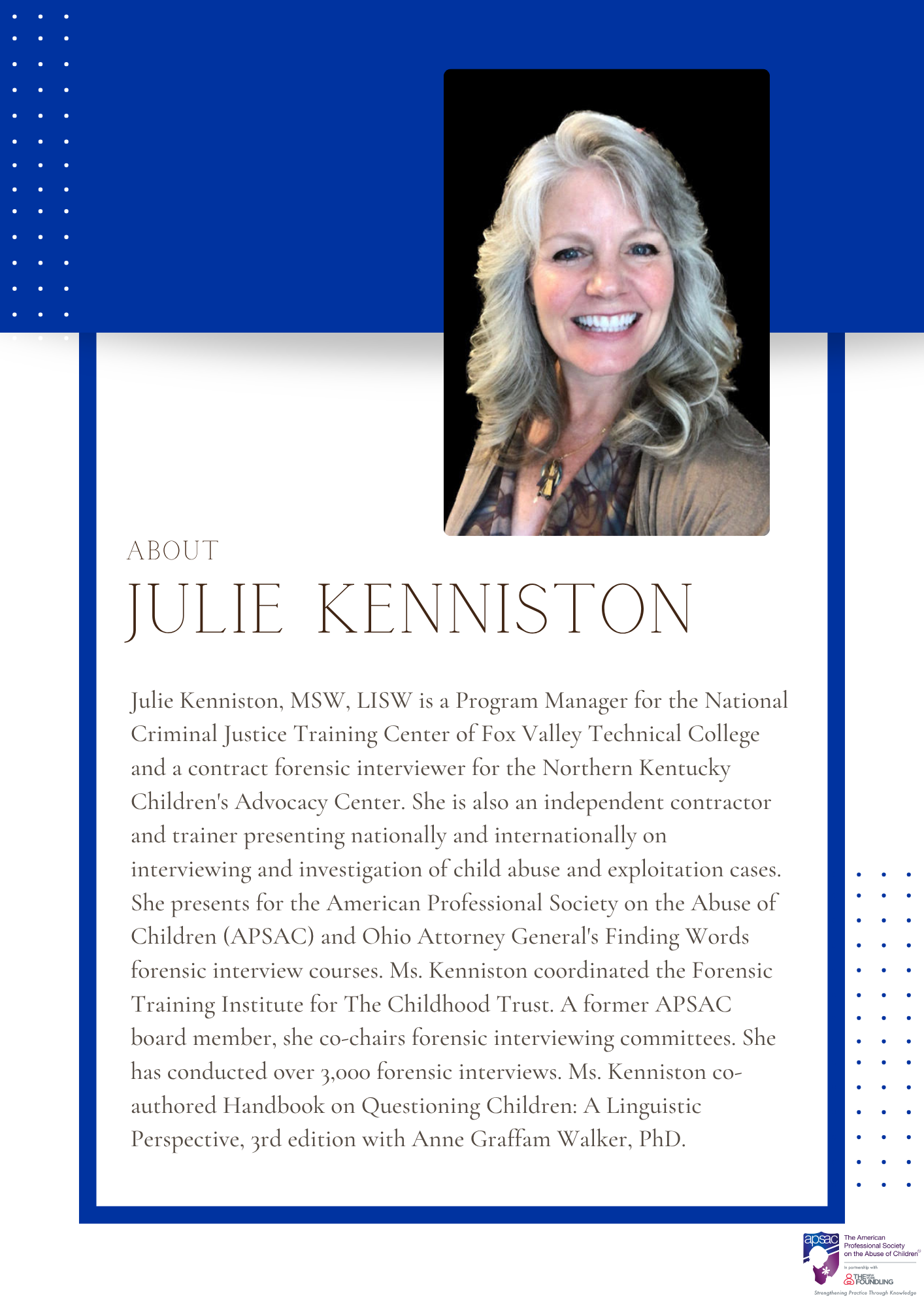
A First-of-Its-Kind, Multi-Module Training SeriesFor professionals who may talk with children about abuse — outside official CAC forensic interview roles. Whether in mental health, healthcare, education, child welfare, law enforcement, or frontline work, gain the skills to respond safely without causing harm. Learn the Why, When & HowSafe, developmentally appropriate, evidence-informed interviewing skills — stay in your role and reduce risk.
| ||||||||||||||||||||||||
| 5/28/2026 -5/28/2026 | 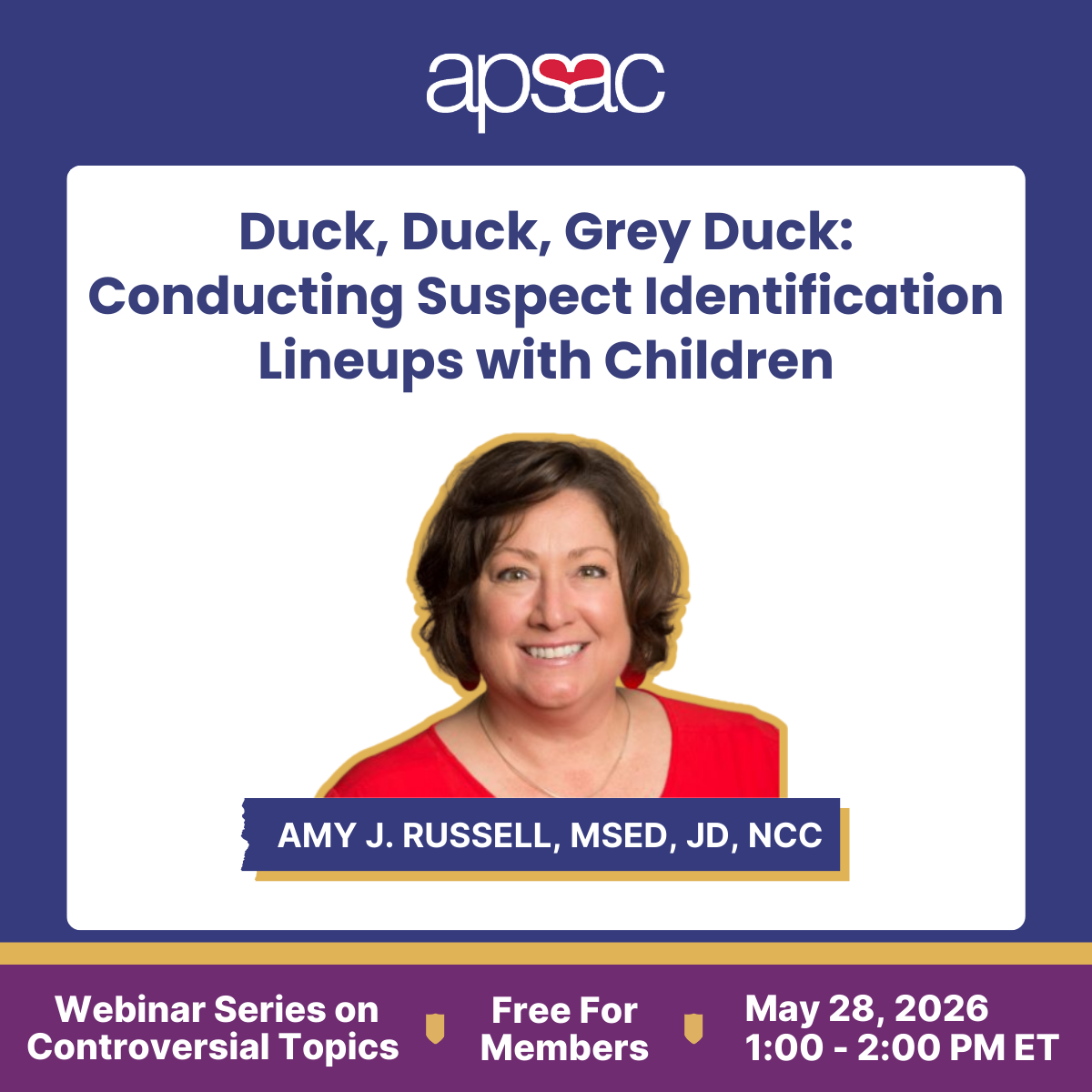 General Admission (individual session): $30.00 APSAC Members and The New York Foundling Staff Admission: Free 1 CE Credit (Social Work & Psychology) Non-Members: $30.00 1 CE Credit (Social Work & Psychology) APSAC Members and NY Foundling: $20.00 APSAC Members: You will receive your discount automatically when registering. The New York Foundling Staff: Please email FontanaCenter@nyfoundling.org to request your entry code. Target Audience and Content Level: Multidisciplinary professionals / Intermediate Interactive, Live Zoom We would love to see you! Please be prepared to have your camera on whenever possible. It helps create a more connected and engaging experience for everyone. If you need to turn it off, we trust you to take care of yourself. If you are requesting continuing education credit, being on camera is required for verification purposes. We appreciate your understanding and participation! Title: Duck, Duck, Grey Duck: Conducting Suspect Identification Lineups with Children Presenter: Amy J. Russell, MSEd, JD, NCC Bio: Amy Russell is an attorney and national certified counselor who has worked with victims of violence and trauma in several capacities, including interviewer for suspected child victims and witnesses of state and federal crimes; counselor for survivors of homicide victims; and pro bono attorney for children in dependency court. She has served as director of several Children's Advocacy Centers; provided national and international training on child abuse and exploitation; serves as an expert witness in child maltreatment cases at the local and federal level; and authored multiple articles on forensic interviewing, child maltreatment and vicarious trauma. Description: Children experience exploitation and witness violence, and may be asked to identify unknown suspects during the course of an investigation. However, children may fail to correctly identify a suspect for multiple reasons. This presentation will review the research on child eyewitness lineup identification; identify issues that may lead to incorrect suspect identifications; and discuss techniques to improve children’s eyewitness accuracy in lineup identifications. Learning objectives: 1. Understand the research on child eyewitness suspect lineup identification, including issues of eyewitness bias, and how it connects to child abuse forensic interviews and investigations
2. Identify memory and trauma issues that may lead children to incorrectly identify a suspect in lineups 3. Discuss techniques to improve children’s eyewitness accuracy in suspect lineup identification procedures References available upon request. Registration will remain open through the start of the WebinarZoom Webinar System Requirements For the best experience, use a computer or mobile device with a stable internet connection. Please have the latest version of Zoom installed, along with working speakers and a microphone. A webcam is required if you're requesting continuing education credit. CE Course Completion Steps
Accessibility Accommodations: To request accessibility accommodations, please contact APSAC at onlinetraining@apsac.org. Provider Statements: Social Work: The American Professional Society on the Abuse of Children (APSAC), provider #1622, is approved as a provider for social work continuing education by the Association of Social Work Boards (ASWB ), www.aswb.org, through the Approved Continuing Education ( ACE ) program. APSAC maintains responsibility for the program. ASWB Approval Period: 7/27/2025-7/27/2028. Social workers should contact their regulatory board to determine course approval for continuing education credits. The Social worker participating in this conference received 1 continuing education clock hours.” Psychology: The American Professional Society on the Abuse of Children, Inc (APSAC) is approved by the American Psychological Association (APA) to sponsor continuing education for psychologists. The American Professional Society on the Abuse of Children maintains responsibility for this program and its contents. Cancellations and Refunds: No cancellations. No refunds. Registration is transferable. Requests for transfer to a future event will also be considered on a case-by-case basis. If you have any questions, please email us at onlinetraining@apsac.org. Questions and Concerns: Please contact the APSAC team at onlinetraining@apsac.org Cancellations: No cancellations. No refunds. Registration is transferable. Requests for transfer to a future event will also be considered on a case-by-case basis. If you have any questions please email us at onlinetraining@apsac.org. more info... | ||||||||||||||||||||||||
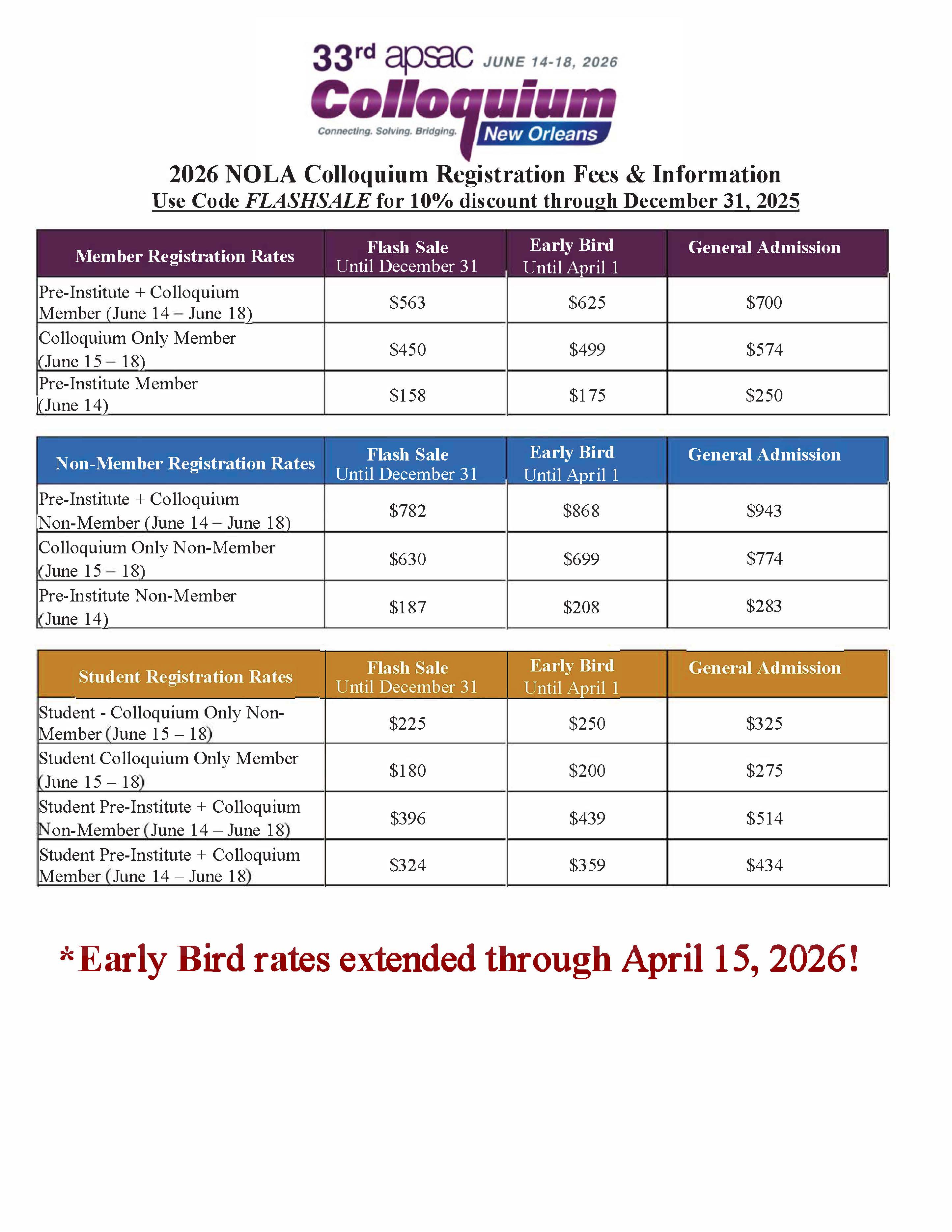
| 6/14/2026 -6/18/2026 | Theme: Connecting. Solving. Bridging. For over three decades, the APSAC Colloquium has been a cornerstone for professionals and researchers working to prevent and respond to child maltreatment. Now in its 33rd year, this go-to conference continues to bring together the field’s most respected voices and emerging innovators for a one-of-a-kind learning and networking experience. The 33rd APSAC Colloquium brings together professionals, researchers, and advocates who believe that real progress happens when we connect across disciplines, solve with shared purpose, and bridge gaps in systems, communities, and understanding. Set in vibrant New Orleans, where collaboration and culture meet, this year’s gathering invites voices to come together -where various voices harmonize like jazz, creating bold, lasting solutions for children and families. For the third year in a row, the Colloquium returns to New Orleans—a city where scholarship meets soul. Attendees don’t just come for the sessions—they return for the connection, culture, and community. Past participants have paraded in second lines, joined jazz-infused bar crawls, and built meaningful collaborations over beignets and bold ideas. Group Registration Discounts Cancellations: APSAC adheres to a No Cancellation and No Refund policy. This long-standing approach is consistent with industry standards for nonprofit conferences and reflects the significant planning and financial commitments that each registration represents. Registration fees cover costs such as venue requirements, materials, and food & beverage which are arranged in advance based on expected attendance. For this reason, all registration fees are final upon submission. Transfer Requests: Unpaid Registrations We appreciate your understanding and continued support of APSAC’s mission to promote excellence and accessibility in the field of child maltreatment prevention and response.
more info... | ||||||||||||||||||||||||
| 10/8/2026 -10/8/2026 |  Description: This workshop will share strategies to help you model for parents what to say and actions to take in order to obtain needed programs, benefits, entitlements and services for their child with a disability. We will share possible barriers and strategies to hopefully help our families overcome those barriers so they can be the best possible advocates for their child and family. The session will allow participants to share their own advocacy victories as well as get feedback pertaining to current difficulties they might be encountering while trying to advocate on behalf of parents. It take more than a village these days, it takes a universe of dedicated advocates to help our vulnerable families. Presenter: Gary Shulman, MS, Ed | ||||||||||||||||||||||||
Events available for Registration... Do No Harm: Interviewing Skills Needed When There?s a Concern of Child Abuse: The Why, The When, and The How 1/5/2026 - 6/18/2026 register for this event... Mental Health Section - 2026 1/6/2026 - 12/1/2026 register for this event... The APSAC Prevention Series 1/15/2026 - 12/17/2026 register for this event... Healthcare Section - 2026 1/20/2026 - 11/17/2026 register for this event... Virginia State Section - 2026 2/10/2026 - 12/8/2026 register for this event... APSAC and New York Foundling 8-Week Course, Technology Solutions and Challenges in Child Maltreatment 3/11/2026 - 4/29/2026 register for this event... YAPSAC Section - Apr 2026 4/21/2026 - 4/21/2026 register for this event... Retired Section Interest Meeting 4/23/2026 - 4/23/2026 register for this event... Do No Harm: Interviewing Skills Needed When There?s a Concern of Child Abuse: The Why, The When, and The How 5/5/2026 - 6/14/2026 register for this event... Mental Health Section - May 2026 5/5/2026 - 5/5/2026 register for this event... Virginia State Section - May 2026 5/12/2026 - 5/12/2026 register for this event... Faith Section - May 2026 5/14/2026 - 5/14/2026 register for this event... APSAC Racial Justice Section presents the Reading Club 5/15/2026 - 5/15/2026 register for this event... Healthcare Section - May 2026 5/19/2026 - 5/19/2026 register for this event... The New York Foundling & APSAC Webinar Series on Controversial Topics 5/28/2026 - 5/28/2026 register for this event... Mental Health Section - Jun 2026 6/2/2026 - 6/2/2026 register for this event... Virginia State Section - Jun 2026 6/9/2026 - 6/9/2026 register for this event... 2026 APSAC Colloquium - New Orleans, LA 6/14/2026 - 6/18/2026 register for this event... DCFS, LA 2026 APSAC Colloquium - New Orleans, LA 6/14/2026 - 6/18/2026 register for this event... Mental Health Section - Jul 2026 7/7/2026 - 7/7/2026 register for this event... APSAC Racial Justice Section presents the Reading Club 7/17/2026 - 7/17/2026 register for this event... Healthcare Section - Jul 2026 7/21/2026 - 7/21/2026 register for this event... Mental Health Section - Aug 2026 8/4/2026 - 8/4/2026 register for this event... Mental Health Section - Sep 2026 9/1/2026 - 9/1/2026 register for this event... Healthcare Section - Sep 2026 9/15/2026 - 9/15/2026 register for this event... APSAC Racial Justice Section presents the Reading Club 9/18/2026 - 9/18/2026 register for this event... Mental Health Section - Oct 2026 10/6/2026 - 10/6/2026 register for this event... Zoom Chat: Advocacy: Supporting Parents of Children with Disabilities? 10/8/2026 - 10/8/2026 register for this event... Mental Health Section - Nov 2026 11/3/2026 - 11/3/2026 register for this event... Healthcare Section - Nov 2026 11/17/2026 - 11/17/2026 register for this event... Mental Health Section - Dec 2026 12/1/2026 - 12/1/2026 register for this event... |
Events in the next 365 days... | ||||||||||||||||||||||||||||||||||||||||||||||||